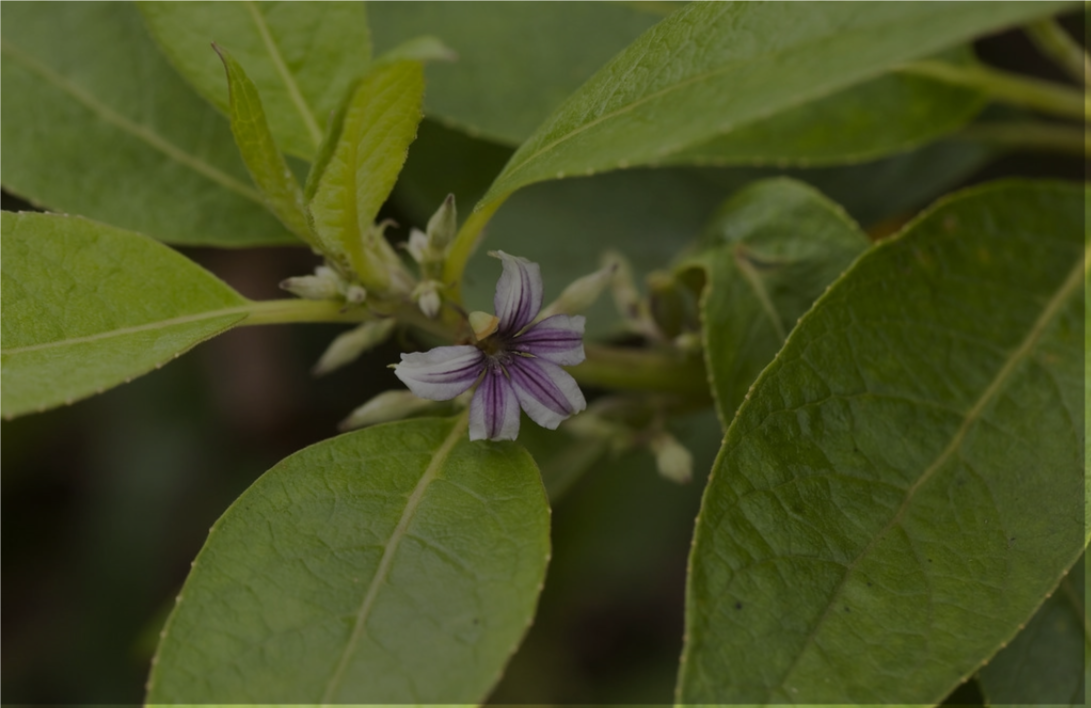

Wikstroemia uva-ursi

A.Gray (1865)

This name is accepted

Kingdom: Viridiplantae Phylum: Magnoliophyta Class/Clade: Eudicot-Rosids Order: Malvales Family: Thymelaeaceae Genus: Wikstroemia

‘ākia [akia], kauhi

img

Description

Key Characters:

Growth Form: Densely branching, prostrate or sprawling shrubs up to 1.5 m tall.

Stems: Young branches very densely gray, yellow, or reddish brown appressed pubescent.

Roots:

Leaves: Leaves simple. Opposite. Blades elliptic, ovate to orbicular, or obovate, (0.9–)1.7–3(–5) cm long, (0.5–)1.2–2.8(–3.8) cm wide. Apex rounded to acute. Base cuneate to rounded, sometimes acute, rarely subcordate. Upper surfaces dark to grayish green; lower surfaces lighter, sometimes glaucous; blades thick and firm.Veins glabrous, with scattered hairs, or pilose, petioles glabrous or with scattered hairs. Margins entire. Pinnately veined. Petioles 1–2.5(–4) mm long. Stipules absent.

Flowers: Flowers in peduncles 1–6 mm long, hirsute, rachis clavate, conical to cylindrical, sometimes forked, 2–20(–50) mm long, hirsute. Flowers unisexual, on Maui sometimes bisexual (perfect), yellow, glabrous, with scattered hairs, or puberulent; pedicels 0.8–3 mm long, glabrous, with a few hairs, or pilose. Calyx tube of staminate flowers 5.5–9(–11.5) mm long, outer lobes 1.5–4.5 mm long, 1–3.8 mm wide, inner lobes 1.2–4 mm long, 1.2– 3.5 mm wide; Calyx tube of pistillate flowers 3.5–8 mm long, outer lobes 1.5–3.8 mm long, 1–3 mm wide, inner lobes 1.2–3.2mm long, 1.2–3 mm wide; Calyx tube of perfect flowers 5–9 mm long, outer lobes 1.6–4.5 mm long, 1.5–3.7 mm wide, inner lobes 1.3–4 mm long, 1.3–3.5 mm wide. Corolla (petals) absent. Stamens 8, the lower whorl included, the upper whorl sometimes shortly exserted. Ovary superior, 1-celled; ovules solitary and pendulous.

Fruit: Fruit bright red to dark crimson; ellipsoid; 8–11 mm long; 5–10 mm in diameter. fruit drupaceous. Seeds without endosperm.

Ploidy: var. <i>kauaiensis</i> (2n = 72*); and var. <i>uvaursi</i> [incl. all basionyms besides var. <i>kauaiensis</i>] (2n : 18*)

Habitat: Rare or scattered on dry ridges; open hillsides; ledges; windswept headlands; clay flats; <i>‘a‘ā</i> lava; coastal; and low; dry; open; alien vegetation.

Elevation Range: 3–420(–670) m.

Historical Distribution

Uses and Culture

USES

PROPAGATION/CULTIVATION

  • Wikstroemia uva-ursi can be propagated by seed, but in some years few fruits are produced. Culliney and Koebele feel that ripe fruit of Wikstroemia are more often available in the fall and winter. The fruit of Wikstroemia uva-ursi is 1/4 to 1/2 inch in diameter, oval berry ranging in color from bright red to dark crimson. The berry generally contains a single seed.
  • Remove the soft outer pulp from mature fruits by rubbing them against the side of a strainer or sieve under running water. Lilleeng-Rosenberger suggests ripening the fruit in a plastic bag to soften the pulp. After this, the seeds can be removed from the pulp more easily. Rather than removing the pulp, Culliney and Koebele suggest cleaning the seeds by putting them in a solution of 1 part bleach and 9 parts water for 1/2 hour. After the seeds are removed from the bleach solution, they should be soaked in tap water for a day using just enough water to cover the seeds. They report germination times of 1 month or more using this treatment.
  • Other sources recommend soaking the seeds in hot water for 24 hours and indicate that seeds will germinate in 21 days to 3 months. However, Lilleeng-Rosenberger's notes indicate that a batch of seeds which was soaked in cold water for 4 days germinated in 14 days. The germination percentage for this batch of seeds was 79%.
  • Culliney and Koebele suggest sowing the seeds on the top of moistened vermiculite and covering them with a layer of moistened green sphagnum moss. As soon as the seeds begin to germinate, remove most of the moss layer.
  • Other sources recommend using a well drained potting mix such as 2 parts perlite to 1 part sterile potting soil. The seeds should be covered with 1/4 inch of mix and watered daily. (Bornhorst 1996; Culliney 1999; Lilleeng-Rosenberger 1996; Lilleeng-Rosenberger 1998; Mew 1987; NTBG 1994; Rauch 1997; Wagner 1990)
  • Wikstroemia uva-ursi can be grown from cuttings, but they require special treatment. Moriarty reported only 50% rooting percentage for untreated tip cuttings. Rauch suggests that propagation is more successful from nursery-grown plants than from plants in the landscape.
  • Herring found that wounding alone did not increase rooting rates. Matsuda and Criley reported that this percentage could increased to 80 to 100% by wounding and use of rooting hormones. Their work was done with 5 to 6 inch long recently matured tip cuttings. These cuttings were wounded by making 2 or 3 one-quarter inch long incisions in the base of each cutting or by the removal of several lower leaves along with a strip of bark.
  • Liquid indolebutyric acid (IBA) at a rate of 3,000 parts per million (ppm) and solutions of Dip'N Grow and water at ratios of 1 to 9 and 1 to 4 all produced 80 to 100 percent rooting in 6 weeks. Dust or powder formulations of 3,000 ppm IBA such as Hormex No. 3 were not as effective as the liquids. Formulations of naphthaleneacetic acid (NAA) were ineffective on unwounded cuttings.The cuttings were stuck in vermiculite and rooted under an intermittent mist of 6 seconds every 2 minutes.
  • Culliney and Koebele, on the other hand, do not recommend the use of rooting hormones for Wikstroemia cuttings. Their procedure is to remove the lower leaves from 4 to 6 inch long tip cuttings. They recommend against removing any more leaves than necessary or reducing the size of any of the remaining leaves. Each cutting is then inserted into a pot filled with moistened medium consisting of one part vermiculite and one part perlite. The pots are put into a humidity chamber such as a covered aquarium or clear plastic cup with a lid. The humidity chambers must be kept out of direct sunlight to avoid overheating the cuttings. The cuttings should be misted lightly with a spray bottle once a day. (Criley 1998; Criley 1999; Culliney 1999; Matsuda and Criley 1980; Herring 1996; Moriarty 1975; Rauch 1997)
  • Wikstroemia uva-ursi can be propagated by air layering. (Bornhorst 1996) [Data from Herring, E. C., & Criley, R. A. (2003). The Hawaiian Native Plant Propagation Web Site: Developing a Webbased Information Resource. HortTechnology, 13(3), 545-548. https://www.ctahr.hawaii.edu/hawnprop/]

Ethnobotanical Images

Natural History

Statewide Status

Endemic

Island Status

Kuaihelani (Midway Atoll) Only found in cultivation
Kaua'i Endemic
O'ahu Endemic
Molokai Endemic
Maui Endemic

Dispersal Agents


Pollinators

Specimens

Notes

  • Description digitized by Dylan Charter
  • Description digitized from the Manual of the Flowering Plants of Hawaii
  • In his posthumously published paper on Hawaiian Wikstroemia Skottsberg (1972) recognized 2 varieties of Wikstroemia uvaursi: var. kauaiensis (2n = 72*), a spreading, often prostrate shrub, young branches densely reddish brown appressed pubes- cent, stems robust, and leaves up to 4 cm long and 3 cm wide (Kaua'i); and var. uvaursi [incl. all basionyms besides var. kauaiensisl (2n : l8*), a densely branching, sprawling shrub, young branches densely gray to reddish brown or yellow appressed pubescent, branches slender, and leaves up to 5 cm long and 3.8 cm wide (O'ahu, Moloka'i, and Maui). It can be very diffi- cult to distinguish the 2 varieties from one another. Wikstroemia uva-ursi is cultivated as an ornamental plant both in municipal parks such as Ala Moana Park and Kapi'olani Park in Honolulu and in private gardens. The decorative foliage and red fruit make this species a valuable and attractive contribution to gardens.

Bibliography

Name Published In: J. Bot. 3: 304 (1865)

Occurrences

SNo. Scientific Name Locality Habitat Basis of Record Recorded By Record Number Island Source Date
1 Wikstroemia uva-ursi Kamakou Preserve, Kupaia Ridge between gulches, East Molokai Montane dry shrubland Preserved_Specimen Pratt, L.W. 1962 Molokai BISH 1985-09-24
2 Wikstroemia uva-ursi Lihue District. Kalepa Ridge, Kalepa Forest Reserve Alien dominated Coastal Mesic Forest Eucalyptus spp, Lophostemon confertus, Casuarina equisetifloius, Grevillea robusta, Rhodmyrtus tomentosa, Waltheria indica, Urochloa maxima, Chamaechrista nictitans, Passiflora laurifolia, Psidium cat. In partial shade next to exposed bare dirt area on E rfacing hillside. Preserved_Specimen Williams, A.M. 83 Kauai BISH 2014-11-14
3 Wikstroemia uva-ursi near summit of west slopes of Halawa Valley Arid scrub Preserved_Specimen Nagata, K.M. 2972 Molokai BISH 1984-06-26
4 Wikstroemia uva-ursi near Kakalele Point, Honokohau Costal bluffs Preserved_Specimen Nagata, K.M. 2963 Maui BISH 1984-06-13
5 Wikstroemia uva-ursi Halawa Preserved_Specimen Corn, C. Molokai BISH 1982-08-22
6 Wikstroemia uva-ursi Coastal bluffs near Kahakuloa Preserved_Specimen Nagata, K.M. 2964 Maui BISH 1984-06-13